 EMAIL
EMAIL  LIST
LIST 
Middle East Crises Highlight Constrained Russia-China-India Cooperation
Richard Weitz, Hudson Institute1
The Middle East has experienced waves of conflicts since the Hamas terrorist organization attacked Israel in October 2023. These conflicts have encompassed all of Israel’s neighbors and Iran’s proxy network, culminating in a major war between Iran and Israel, partly joined by the United States, in June. Iran’s defeat, combined with Israeli and US ruminations about the prospects for regime change in Tehran, presented the Iranian regime with an “existential challenge.”2 Russia, China, and India had minimal impact on these potentially critical conflicts. Reflecting on the recent war in late July, US Secretary of State Marco Rubio observed that Iran’s partners “all kind of took a pass and said we don’t want to get involved” after the United States “reminded the world that we have a strong President and the most extraordinary military capabilities in the world.”3 With the end of the fighting, though, these governments could adopt a more assertive stance to elevate their regional influence or recalibrate their relations in response to the reassertion of US power. Additionally, several wildcards in the notoriously volatile Middle East could transform Russian, Chinese, and Indian policies in the region.
This article first reviews the reactions of the Russian, Chinese, and Indian governments to the recent wars in the Middle East, especially the June 2025 war. The next section evaluates the reasons for their modest response. One common theme is that these three governments arguably have more important relations with other countries than with Iran. The final section considers potential future developments that could impact Russian, Chinese, and Indian policies and interactions.
Reticent Reactions
After Israel launched Operation Rising Lion against Iran’s nuclear and military infrastructure on June 13, Putin arranged emergency phone calls with the leaders of Iran and Israel. Besides criticizing the attacks, Putin proposed “specific initiatives” to resolve the crisis peacefully to Iranian President Masoud Pezeshkian.4 He informed Israeli Prime Minister Benjamin Netanyahu that Moscow would only back “political and diplomatic means” to end the crisis but offered to mediate the conflict toward that end.5 Even before Israel attacked, Moscow had striven to sustain the US-Iranian nuclear dialogue and keep the United States from using force against Iran. Following Israel’s air strikes, Russia focused on averting US intervention on Israel’s behalf.6 During a June 14 phone call with Trump, Putin encouraged Washington to continue negotiations with Tehran.7 Additionally, the Russian government offered to dispose of some of Iran’s enriched uranium, as Russia did through the 2015 Joint Comprehensive Plan of Action (JCPOA), as a contribution to any new deal. Meanwhile, Russian officials warned that US military intervention could precipitate regional destabilization and potentially nuclear war.8
The Russian efforts failed. Without informing Moscow in advance, the Pentagon launched “Operation Midnight Hammer” against three of Iran’s most sensitive nuclear facilities on June 22.9 The Russian Foreign Ministry denounced the US strike as an “irresponsible decision” and “a gross violation of international law, the UN Charter, and resolutions of the UN Security Council.”10 Russia’s UN ambassador accused Washington of opening a “Pandora’s box” that “could have completely unpredictable consequences” by precipitating “an era of uncontrolled nuclear risks.”11 Konstantin Kosachev, chair of the Federation Council’s foreign affairs committee, warned the strike could incentivize nuclear proliferation: “The message to so-called ‘threshold’ nations couldn’t be clearer: if you don’t want to be bombed by the West, arm yourself. Build deterrence. Go all the way.”12 Some prominent commentators even saw a direct threat to Russia’s security. Sergey Markov maintained that “ironically, Iran’s restraint – its perceived “peacefulness” – has paved the way to war. There’s a lesson in that for Russia.” 13 Alexander Dugin warned that “if nothing stopped them from bombing Iran, then nothing will stop them from targeting us next.”14
When Iranian Foreign Minister Abbas Araghchi met Russian leaders in Moscow on June 23, Putin said his visit “provides an opportunity to discuss these sensitive issues and jointly consider ways” to address the current situation.15 Though Araghchi thanked his interlocutors for condemning the attacks on Iran, Russian officials declined to pledge concrete military or economic support.16 (There are conflicting reports on whether Araghchi requested military assistance.17) In any case, the Russian government did not punish the United States or rush military aid to Iran, choosing instead to continue the Russian-US dialogue regarding Ukraine and other issues.
China’s public stance regarding the war resembled that of Russia, with some rhetorical variations. Throughout the crisis, PRC messaging contrasted alleged Israeli and US belligerence with China’s responsible non-interventionist behavior and commitment to international law. Chinese diplomats condemned the use of military force, defended Iran’s right to a civilian nuclear program and self-defense, and called for mutual restraint and a ceasefire. On June 18, Xi warned that further escalation would challenge “the common interest of the international community."18 In a phone call with Putin the following day, Xi called for a ceasefire, protection of civilians, a political resolution of the Iranian nuclear issue, and for the Security Council and major powers to play the lead role in ending the conflict.19 Foreign Minister Wang Yi told Araghchi that “China explicitly condemned Israel’s violation of Iran’s sovereignty, security, and territorial integrity.”20 On June 22, the Foreign Ministry blasted the United States for joining the conflict, condemning the US air strike on Iran’s nuclear facilities as having “seriously violat[ing] the purposes and principles of the UN Charter and international law, and … exacerbate[ing] tensions in the Middle East.” Nonetheless, the Ministry reaffirmed Beijing’s readiness “to work with the international community … for restoring peace and stability in the Middle East.”21 PRC broadcast and social media were even more critical of Israeli and US actions, reinforcing Iranian media messaging while affirming China’s capacity to thwart a comparable US military strike on China.22
On June 26, the day after the Iran-Israel ceasefire took effect, Iran’s Aziz Nasirzadeh attended a previously scheduled meeting of the defense ministers of the Shanghai Cooperation Organization (SCO) in the Chinese coastal city of Qingdao. At the June 26 meeting, PRC Defense Minister Dong Jun denounced “[u]nilateralism and protectionism … hegemonic, high-handed, and bullying acts” and other language PRC representatives typically use to characterize US policies.23 Nasirzadeh “expressed gratitude to China for its understanding and support of Iran’s legitimate stance” and “hopes that China will continue to uphold justice and play an even greater role in maintaining the current ceasefire and easing regional tensions.”24 Beyond relying on routine rhetoric and ineffective multilateral resolutions, however, China took no concrete steps to achieve a ceasefire, mediate the conflict, or avert further escalation by threatening economic measures such as sanctions.25
The Indian government’s reaction to the June 2025 war, though employing more balanced rhetoric, was also restrained. After Israel attacked Iran on June 12, Minister of External Affairs Subrahmanyam Jaishankar “conveyed the deep concern of the international community” to his Iranian counterpart. Yet, he also “urged avoidance of any escalatory steps and an early return to diplomacy.”26 The next day, Prime Minister Narendra Modi spoke with Netanyahu by phone, similarly emphasizing “the need for early restoration of peace and stability in the region.” On June 13, the Ministry of External Affairs also issued a finely balanced statement. Noting that “India enjoys close and friendly relations with both the countries,” the ministry expressed deep concern at the recent fighting, called for “both sides to avoid any escalatory steps,” and advocated using “[e]xisting channels of dialogue and diplomacy” to resolve the crisis.27 It was only on June 23, following the US air strikes against Iran’s nuclear sites, that Modi spoke with Pezeshkian. The prime minister called for “immediate de-escalation, dialogue and diplomacy as the way forward and for early restoration of regional peace, security and stability.”28 Through “Operation Sindhu,” the Indian government rapidly removed 4,500 Indian citizens who wanted to evacuate both countries.29 Unlike Russia and China, however, India declined to support the June 14 SCO statement censuring Israel for “aggressive actions [that] constitute an infringement on Iran’s sovereignty, cause damage to regional and international security, and pose serious risks to global peace and stability.”30 The Indian government asserted that it had not participated in the statement’s drafting.31
Explaining the Responses
During the past decade, Russian leaders have welcomed how the current Iranian government regularly challenges the West, balances Turkey’s influence in the South Caucasus and Middle East, and displays indifference toward how the Russian government treats its Muslim minorities. Moscow has been Iran’s leading foreign arms supplier since the mid-1980s. Before December 2024, Russian-Iranian military cooperation proved critical for sustaining Syrian President Bashar al-Assad in power. Iran also supplied drones, missiles, and other support when the Russian defense industry was struggling to sustain Moscow’s protracted war against Ukraine.32 In some recent years, Russian companies have provided Iran’s largest source of foreign direct investment through their participation in several large energy projects. The two governments are partnering to construct the International North–South Transport Corridor (INSTC), which will expand their regional commerce. Located in the world’s two most sanctioned countries, Russian and Iranian entities have collaborated extensively on sanctions evasion and the use of non-Western currencies in their joint transactions.
In January 2025, Russia and Iran signed a Comprehensive Strategic Partnership Treaty. Though the text references “military-technical” cooperation and prohibits either signatory from aiding any state that attacks the other party, the agreement does not commit Russia or Iran to render military assistance to the other in such situations.33 Furthermore, Russian-Iranian collaboration has remained weaker than Moscow’s considerably closer partnerships with China, North Korea, and India. Ideological differences, historical animosities, and lack of trust have long impeded deep Russian-Iranian cooperation, even as these ties provide leverage for tactical advantages vis-à-vis third parties. Iran’s value for the Kremlin has declined due to the end of their joint military campaign in Syria, Iran’s debilitated military and proxy network, and Moscow’s extensive commercial and diplomatic ties with Gulf Cooperation Council (GCC) governments eager to constrain Iranian military power.
Despite Russian diplomats’ hostile rhetoric regarding Israeli actions in Gaza and Iran, the Russian and Israeli governments have sustained a mutually acceptable security arrangement regarding Syria, Ukraine, and other issues during the past decade. The Russian air force did not contest Israeli military operations in Syria, while Israel limited its defense ties with Ukraine and its sanctions on Russia. During the St. Petersburg International Economic Forum on June 20, Putin cited the presence of approximately two million former Soviet nationals in Israel as another reason why Russia had not confronted Israel more intensely.34 Moscow also wanted to prevent Israel from acquiescing to Western pressure to provide military assistance to Ukraine. On July 24, Foreign Minister Gideon Saar became the most senior Israeli official to visit Ukraine since 2023. Saar met with President Volodymyr Zelenskiy and other Ukrainian leaders. Both sides publicly expressed concern about military threats from Iran. Though Saar did not make any overly negative comments about Russia, he observed that limiting Iran’s military technology enhanced European security. Zelenskiy stated that the two governments discussed joint arms manufacturing and improving Ukraine’s air defenses. 35
Another constraint on Russian support for Iran in June 2025 was Putin’s desire to cultivate personal relations with President Trump in the hopes of improving Russian-US ties, reducing Western sanctions, or at least decreasing US military support for Ukraine. When the fighting ended, Kremlin spokesperson Dmitry Peskov said that Russia would compartmentalize US military actions in Iran from other dimensions of the Russian-US dialogue.36 Still, Trump declined Putin’s offer to mediate, remarking that Putin could more beneficially negotiate an end to the Ukraine War. Trump seems keen to deal directly with the Iranian leadership rather than through intermediaries. His rapid declaration of an Israeli-Iranian truce helped avert a protracted conflict, which would have elevated oil prices and boosted Russia’s revenue.37
China’s quiescence during the June 2025 conflict was equally striking. Approximately half of the PRC’s imported oil flows through the Strait of Hormuz, including as much as 90 percent of Iranian oil exports.38 This high figure is due both to China’s enormous demand for crude and the paucity of competing purchasers; their fear of incurring US sanctions allows the PRC to buy Iranian oil at a discount. Enveloping Iran within Beijing’s Belt and Road Initiative (BRI) is another Chinese objective. In addition to expanding China’s commercial exports through the Indian Ocean, PRC-controlled infrastructure at Gwadar and other Pakistani ports comprising the China-Pakistan Economic Corridor could help the PRC and Pakistan encircle their mutual rival, India. In March 2021, the Chinese and Iranian foreign ministers signed a 25-year Comprehensive Strategic Partnership agreement to lay a foundation for extensive long-term economic and energy ties between the two countries. From another perspective, though, Iran provides only some 12–20 percent of China’s oil imports, approximately the same share as Russia supplies the PRC, while Chinese investment and trade with other countries, including in the Middle East, is much greater than with Iran. Analysts therefore look beyond commercial considerations and see Beijing’s large purchases of Iranian oil as China’s way of helping sustain the Iranian economy, military, and regime without the risks of rendering more direct support.39
Like China, India would like to resolve the Iran nuclear dispute to decrease international sanctions on its transactions with Iran. India ceased importing Iranian oil in 2018 due to these sanctions.40 India’s most important investment in Iran remains the Chabahar Port in the southeastern Sistan-Baluchestan province on the Gulf of Oman, 140 km west of Gwadar. India has spent millions of dollars developing the port, which is critical for enhancing India’s trade with Central Asia and Afghanistan. The goal is for rail and road networks to convey goods between the port and Afghanistan, the Central Asian republics, and potentially other countries, such as Russia, that participate in the INSTC, without transiting Pakistani territory. 41 However, Western sanctions on Iran, Russia, and the Afghan Taliban, along with other challenges, will likely continue to hobble India’s realization of its Chabahar-related projects.
China’s regional integration efforts regarding Iran have been a source of Indian-Iranian tensions. Indian strategists worry that Beijing could outmaneuver India by drawing Iran into its foreign commercial networks to the detriment of India’s economic and security goals. For instance, New Delhi opposes Iran’s participation in the China-Pakistan Economic Corridor, a multibillion-dollar infrastructure and regional integration project bankrolled by Beijing, because it encompasses Pakistani territory that India claims. 42 Conversely, the Modi government has welcomed how Tehran has recently favored India in its confrontation with Pakistan. The Iranian foreign minister flew to India during its April war with Pakistan to show solidarity with New Delhi. China disapproves of this Iranian stance since Beijing considers Pakistan one of its closest partners and has strained relations with India.
Like Russia and China, India’s economic ties with some other Middle Eastern countries vastly exceed those with Iran. India’s commerce with the GCC states collectively has grown exponentially in the past two decades. It is now some twenty times greater than the volume of India-Iranian trade.43 Though India no longer buys Iranian oil and has purchased large volumes of discounted Russian crude since Russia invaded Ukraine in February 2022, India still obtains most of its imported oil from the GCC states.44 India has also dramatically expanded its non-hydrocarbon commerce with Saudi Arabia, the UAE, and other GCC countries. The Gulf monarchies host millions of Indian workers who send enormous funds back to India as remittances.45 Furthermore, India’s military cooperation with GCC countries has been growing and now includes arms sales, joint training, and exercises.46 India is also pursuing alternative international transportation projects that circumvent Iranian territory, including the India-Middle East-Europe (IMEC) corridor (which runs from India’s west coast ports to the UAE, Saudi Arabia, Jordan, Israel’s port of Haifa, and then the European Union) and the I2U2 (Israel-India-United States-United Arab Emirates) Group, which prioritize high-tech and other leading-edge sectors.47 The importance of these economic sinews partly explains the frequent visits Modi and other influential Indians make to the GCC states.
Importantly, one reason the Indian government cultivates ties with these and other Middle Eastern countries is to compete with China and Pakistan, which have sought to secure support against India in the region by appealing to Muslim solidarity.48 New Delhi’s animosity with Islamabad may partly explain why, at an emergency June 22 UN Security Council session, India did not back a proposed Russia-China-Pakistan joint resolution censuring Israel and calling for “an immediate and unconditional ceasefire.”49 Indian diplomats are wary of the China-Pakistan alignment against India, along with Pakistan’s growing ties with Russia, which remains an important defense partner of India. Looking ahead, the Indian government will maintain its strategic autonomy as New Delhi balances ties between Russia, China, Iran, and other partners.
Though India’s close ties with Israel complicate New Delhi’s policies in the Middle East, sustaining the Indian-Israeli partnership has been a priority of the Modi government. The two countries’ annual trade amounts to only some $4 billion, but Indian-Israel commerce and investment encompass sensitive sectors such as high technology, cybersecurity, and weapons systems.50 Israel has both transferred important military technology to India and co-developed weapons systems with Indian firms. This cooperation has encompassed drones, radars, missiles, AI software, and other defense projects.51 Since both Indian and Israeli national security managers identify threats from Muslim extremists, they have cooperated against terrorism despite partially diverging priorities and threat perceptions.52 Due to these strong Indian-Israeli ties, the Indian government has declined to follow Russia, China, and Iran in routinely attacking Israeli policies, though this position may prove harder to sustain as more governments censure Israeli actions in Gaza.
Indian leaders also anticipate that having good relations with Israel helps strengthen Indian ties with the United States, which has become a preeminent defense partner for India since the Cold War.53 New Delhi has striven, with mixed success, to avoid antagonizing the Trump administration, which has penalized countries in trade negotiations for pursuing policies perceived as hostile to US interests. Soon after assuming office, the administration rescinded previous sanctions waivers on India’s transactions with Iran, including sanctions related to India’s Chabahar Port project.54 At the time of the Israeli-Iran war, New Delhi was engaged in contentious tariff talks with Washington.55
Wildcard: Syria as a Source of Trilateral Collaboration or Conflict?
In his July 28 phone call with Netanyahu, Putin called on Israel to uphold “the unity, sovereignty, and territorial integrity of the Syrian Arab Republic.”56 His comments reflect Moscow’s desire to maintain influence, including a military presence, in Syria despite the collapse of the Kremlin-aligned Assad regime. The very Islamist militants that Russia’s decade-long bombing campaign had targeted dominate the new provisional authorities. Some Israeli officials have expressed support for sustaining a Russian military presence to balance Turkey and hinder the new regime’s consolidation of power. Though the Russian, Chinese, and Indian governments share Israeli anxieties about Syria again becoming a haven for transnational terrorists, they aim to work with the new provisional authorities and their Arab and Turkish backers to avert such an outcome. All three seem prepared to respect Israeli and US concerns by limiting Iranian influence in Syria.
The situation will remain fluid due to Syria’s complex internal mosaic and the many competing external actors—conditions that fueled the decade-long civil war. If the Syrian economy improves, Russian, Chinese, and Indian firms would likely bid on reconstruction contracts and perhaps establish joint ventures with one another. If Syria descends again into protracted civil strife, Russian, Chinese, and Indian policies could conflict due to their potentially diverging interests and priorities. Already, though PRC officials have echoed Russian criticisms of Israel’s assertive stance regarding Syria, their Indian counterparts have adopted a less reproachful stance.
Wildcard: Revival of the Russia-India-China Troika Format?
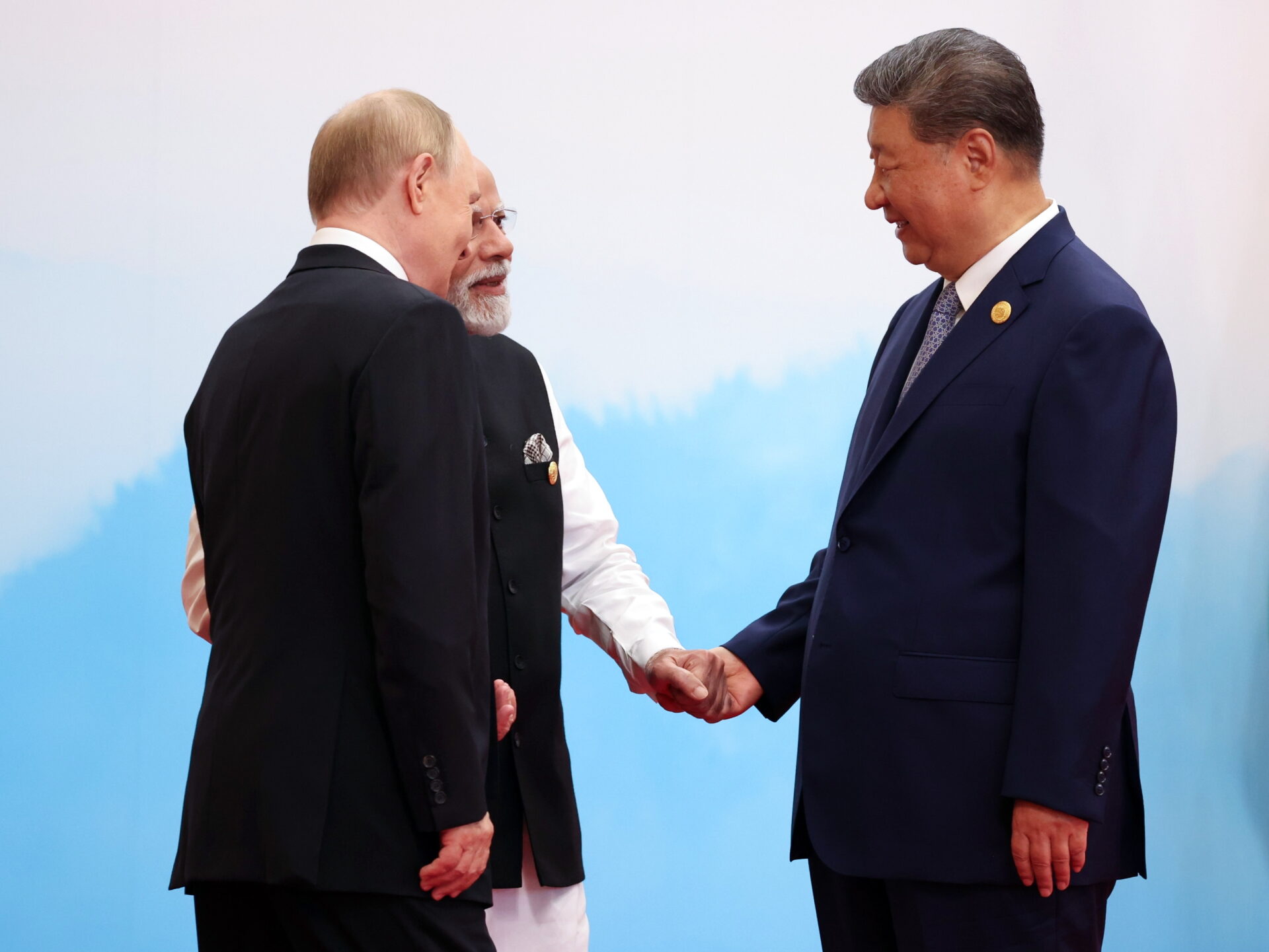
Middle East developments may motivate Moscow, Beijing, and New Delhi to resuscitate the dormant Russia-India-China (RIC) troika. Though all three countries are full members of BRICS and the SCO, the RIC format provides for separate meetings exclusively among their senior ministers. Immediately before the June 2025 war, Lavrov declared that Moscow wanted to renew this format, which has been in abeyance in recent years. Lavrov cited recent progress regarding the Sino-Indian border dispute as removing a major obstacle to its revival.57 With Moscow’s encouragement, Beijing and New Delhi reached a disengagement agreement in October 2024.58 In July, Deputy Foreign Minister Andrey Rudenko confirmed that he had discussed reviving the format with both the PRC and Indian governments.59 Foreign Ministry Spokesperson Lin Jian confirmed the PRC’s openness to the proposal, observing that “cooperation among China, Russia, and India not only aligns with the respective interests of the three countries, but also contributes to regional and global peace, security, stability, and progress.”60
Reviving the RIC format would advance the Russian and Chinese objectives of promoting a multipolar world with strong power centers independent of the West. Lavrov acknowledged Moscow’s concerns that Western governments were trying to pull India into their containment campaigns against Russia and China.61 PRC leaders have the same anxieties about keeping India from aligning too closely with the West.62 Chinese writers have noted that the three countries now have greater economic and diplomatic weight in the world than when the RIC format began in the 1990s.63 The Russian media cited a Chinese expert at Tsinghua University’s Institute of National Strategy, who recommended following a strategy of building on small economic steps, beginning with less sensitive topics such as climate governance and digital trade.64 An earlier Russian study recommended pursuing regional payment systems to decrease dependence on US dollar transactions and leveraging the three countries’ regional economic integration projects—Moscow’s “Greater Eurasian Space” concept, Beijing’s BRI, and the INSTC—to expand mutual trade in high-value products.65
Indian officials share Chinese concerns about US tariff policies and sanctions on their imports of Russian oil.66 In the past, New Delhi’s persistent tensions with China and its reluctance to align too closely with any great power bloc, whether led by Washington or by Moscow and Beijing, remained an impediment to the troika’s restoration. The Indian government was initially noncommittal regarding the troika format.67 But the escalating tensions with the United States, especially the Trump administration’s harsh tariff policies and perceived tilt toward Pakistan, may lead New Delhi to pursue closer ties with Moscow and Beijing simply to hedge against a sustained rupture with Washington.68 Modi will make his first trip to China in seven years to attend the August 31 SCO summit.
Additionally, the war highlighted China’s “Hormuz Dilemma,” in which its access to Gulf hydrocarbons is vulnerable to military conflicts, regime changes, and maritime security disruptions. 69 Beijing may respond by seeking to expand access to oil and gas imports from nearby land-based sources. 70 This could include Russia, which has sought to build additional pipelines to China. This scenario would strengthen Sino-Russian relations. However, Central Asia could provide another source, since the region has large deposits of oil and gas, and China already imports many of its hydrocarbons through land-based pipelines. Central Asia has generally been an area of Sino-Russian cooperation, with Russian and Chinese companies jointly participating in many oil and gas projects, but the region could see greater Sino-Russian tension in the future.
Conclusion and Prospects
The governments of Russia, China, and India share important interests regarding Iran. At the global level, all four regimes are, to varying degrees, dissatisfied with the prevailing Western-dominated international system. Moscow and Beijing favor a strong Iran to promote a multipolar world and distract US resources from Europe and Asia, areas they consider more important. Since 2019, Russia, China, and Iran have engaged in five joint naval exercises in the Gulf of Oman and the Indian Ocean. Following an initial drill in December 2019, the three navies have exercised together annually since 2022. Iran became a full member of the SCO in July 2023 and joined the BRICS Plus bloc—whose core members include Russia, China, and India, along with Brazil and South Africa—starting in January 2024. Russia and China are Iran’s leading foreign economic partners, while India would like to resume purchasing Iranian oil. Their firms all seem prepared to bid on contracts to rebuild Iran’s infrastructure.
Despite these extensive ties and overlapping views regarding Iran, the three governments largely failed to coordinate their responses during the June 2025 war. Russian-Chinese cooperation comprised only joint statements and backing UNSC resolutions calling for an immediate end to the fighting. Meanwhile, the Indian government operated almost entirely independently of Moscow and Beijing during the war, notably standing aside from Sino-Russian efforts in the UN and SCO to support Iran diplomatically. None of the three governments issued threats to the parties to end the fighting, deter escalation, or avoid post-truce hostilities. Israel, the United States, and even Iran ignored Russian and Chinese offers of mediation, which Moscow and Beijing did little to press in any case. Trump effectively ended the fighting by unilaterally announcing a truce and forcing Israel to comply.
A major reason for their restrained response during the war was that Russian, Chinese, and Indian policymakers considered their economic and security ties with some other countries at least as important as their relations with Iran. Neither Moscow nor Beijing aimed to transform the 12-day Israel-Iran war into a proxy confrontation with the United States. Furthermore, the three governments may have struggled to make policy in such a fast-breaking crisis. The Russian military remains bogged down in Ukraine, while China and India have yet to develop rapid power-projection capabilities beyond Asia. Moreover, the leaders of Russia, China, and India all favor preserving the security status quo regarding Iran. They have opposed calls among Iranians to leave the Nuclear Non-Proliferation Treaty (NPT) or acquire nuclear weapons. Tehran’s pursuit of nuclear weapons would elevate the prospect of another Middle Eastern war that would threaten China’s and India’s energy supplies and decrease their regional trade and investment opportunities. Iran’s acquisition of nuclear weapons could also lead additional countries to seek them, including Germany, Poland, Turkey, Japan, South Korea, and other potential military adversaries of Russia or China. Additionally, a nuclear-armed Iran would rely less on Russian and Chinese support and therefore become less pliable to their influence.
A war could also lead to regime change in Tehran, which would be particularly unwelcome in Moscow and Beijing. During the June fighting, both Netanyahu and Trump stated that, while replacing the Iranian regime was not an explicit war aim, its demise would not be unwelcome.71 The present friction between Iranians and the West leaves Russia and China as Iran’s major economic partners, diverts US attention and pressure away from Russia and China, and positions Moscow and Beijing as possible mediators between Iran and the West. A more radical Iranian government could encourage or even support Islamist movements in Russia, China, India, or elsewhere. Conversely, a more pro-Western government might punish Moscow and Beijing for their past support for Iran’s clerical dictatorship by, for example, redirecting Iran’s diplomatic and economic ties toward the West at Russia’s and China’s expense.
The Kremlin’s immediate focus has been on preventing renewed Israeli or US attacks on Iran, primarily through diplomatic communications, offers of mediation, and advocating for a new nuclear deal with Iran. On July 28, Putin told Netanyahu that Moscow wanted to “resolv[e] the problems and conflicts arising in the region exclusively via peaceful means.”72 Russian officials blame the 2018 US withdrawal from the JCPOA for exacerbating the Iran nuclear crisis and criticize the June 22 US bombing of Iran’s nuclear facilities as undermining international efforts to ensure the peaceful nature of Iran’s nuclear program. But the Russian government has called on the Iranian government to continue cooperating with the International Atomic Energy Agency, which monitors Iran’s nuclear sites.73 Russian analysts have warned that, should Iran withdraw from the NPT, “it risks damaging ties with Moscow and Beijing—neither of which wants to see a challenge to the existing nuclear order.”74 Russia has offered to remove or downblend what Lavrov has termed Iran’s “excessively enriched” uranium (i.e., having a higher concentration than the 3.67% needed for commercial power reactors).75
Since the June war, Iranian officials have set aside any irritation at the three governments’ limited support during the war and striven to deepen ties with these countries. For example, Araghchi discussed cooperative projects with Lavrov, Xi, Jaishankar, and Wang Yi on the sidelines of the July 15 SCO Council of Foreign Ministers session in Tianjin. Iranian officials hope that the INSTC, which connects Iranian ports, backed by Chinese investment, with Russian and Indian logistical networks, will further deepen ties among the four countries.76 Nonetheless, the Kremlin has been striving to parry accusations, by Iranians and others, that Russia provided insufficient support to Iran and its partners during its conflicts with Israel and the United States. These complaints strain Russian-Iranian relations and decrease Moscow’s military reputation in the Middle East.77 Observing that “there are many who would like to pour fuel on the fire and damage the partnership between Moscow and Tehran,” Peskov insisted that “Russia has indeed supported Iran through the clear position it has taken,” adding that “we intend to continue developing our relationship with Iran.”78 Some Russians have called for providing Iran with substantial military assistance to bolster bilateral ties, reinforce Russian military commitments, or accelerate its postwar recovery.
China could also help Iran rebuild its military power. Despite the seeming success of PRC weapons during the recent India-Pakistan fighting, China did not provide weapons to Iran during the war. When asked about the issue, PRC Defense Ministry spokesperson Zhang Xiaogang told CNN that “China is willing to work with all parties to play a constructive role in maintaining peace and stability in the Middle East.”79 From Tehran’s perspective, China would be a natural arms seller. Not only did the PRC sell weapons to Iran earlier, but Pakistan made good use of Chinese warplanes to shoot down several of India’s most advanced fighters.80 Acquiring large numbers of Chengdu J-10C Vigorous Dragon multirole aircraft or another advanced Chinese fighter would fill a critical gap in Iran’s air defenses and provide another means of projecting power besides missiles and drones. If Russia or China do resume selling major weapons systems to Iran, the parties would likely also try to conceal the transactions by supplying dual-use items or shipping military-technical goods through third parties such as North Korea to conceal the collaboration.
Notes
1. The author would like to thank Jack Feise, Marie Mach, and Konstantin Shchelkunov for their research assistance in preparing this article.
2. Thomas Grove and Bojan Pancevski, “Why Russia Is Giving Iran the Cold Shoulder After Israel Attack,” The Wall Street Journal, June 24, 2025, https://www.wsj.com/world/russia-putin-israel-iran-trump-4c89855e.
3. “Secretary of State Marco Rubio with Lara Trump of Fox News,” US Department of State, July 21, 2025, https://www.state.gov/releases/2025/07/secretary-of-state-marco-rubio-with-lara-trump-of-fox-news/.
4. Vladimir Putin, “Телефонные разговоры с Президентом Ирана Масудом Пезешкианом и Премьер-министром Израиля Биньямином Нетаньяху,” President of Russia, June 13, 2025, http://kremlin.ru/events/president/news/77181.
5. ibid.
6. Vladimir Soldatkin and Andrew Osborn, “Russia tells US not to strike Iran, warns of nuclear catastrophe” Reuters, June 18, 2025, https://www.reuters.com/world/middle-east/russia-warns-us-not-help-israel-militarily-against-iran-2025-06-18/.
7. Yury Ushakov, “Комментарий помощника Президента России Юрия Ушакова по итогам телефонного разговора Владимира Путина с Президентом США Дональдом Трампом,” President of Russia, June 14, 2025, http://kremlin.ru/events/president/news/77187.
8. “РФ предостерегла США от оказания прямой военной помощи Израилю,” Interfax, June 18, 2025, https://www.interfax.ru/world/1031818.
9. Robyn Dixon and Natalia Abbakumova, “Russia condemns US strikes on Iran but takes no concrete actions,” The Washington Post, June 23, 2025, https://www.washingtonpost.com/world/2025/06/23/iran-russia-alliance-strikes-nuclear/.
10. “Заявление МИД России в связи с американскими ударами по территории Ирана,” Russian Foreign Ministry, June 22, 2025, https://mid.ru/ru/press_service/spokesman/official_statement/2029109/.
11. “Постоянное представительство Российской Федерации при ООН,” Permanent Mission of the Russian Federation to the UN, June 22, 2025, https://russiaun.ru/ru/news/22062025. See also: Vasily Nebenzya, “Небензя заявил об открытом «ящике Пандоры» из-за атаки США на Иран,” RBC, June 22, 2025, https://www.rbc.ru/rbcfreenews/6858620d9a7947382a42596e.
12. “’If Iran falls, we’re next’: What Russian experts and politicians are saying about the US strikes,” RT, June 22, 2025, https://www.rt.com/russia/620253-if-iran-falls-were-next/. See also: Nikolai Bobkin, “Иран держит удар,” InfoShOS, June 29, 2025, http://www.infoshos.ru/ru/?idn=42512; and Ilya Kramnik, “Полночный молот между политикой и технологией,” IMEMO Policy Briefs, June 23, 2025, https://www.imemo.ru/publications/policy-briefs/text/polnochniy-molot-mezhdu-politikoy-i-tehnologiey.
13. “’If Iran falls, we’re next’.” See also: Kamran Gasanov, “Как израильско-иранская война влияет на ситуацию на Украине и переговоры между Россией и США,” Valdai Discussion Club, June 25, 2025, https://ru.valdaiclub.com/a/highlights/izrailsko-iranskaya-voyna/.
14. “’If Iran falls, we’re next’.”
15. Vladimir Putin, “Встреча с Министром иностранных дел Ирана Аббасом Аракчи,” President of Russia, June 23, 2025, http://kremlin.ru/events/president/news/77237.
16. ibid.
17. Thomas Grove and Bojan Pancevski, “Why Russia Is Giving Iran the Cold Shoulder After Israel Attack,” The Wall Street Journal, June 24, 2025, https://www.wsj.com/world/russia-putin-israel-iran-trump-4c89855e.
18. Micah McCartney, “Xi Jinping Breaks Silence on Israel-Iran Conflict As China Warns Citizens,” Newsweek, June 18, 2025, https://www.newsweek.com/china-xi-jinping-central-asia-visit-reacts-israel-iran-conflict-embassy-travel-alert-2087100.
19. “Xi says ceasefire an urgent priority in Middle East during phone talks with Putin,” Xinhua, June 19, 2025, https://english.www.gov.cn/news/202506/19/content_WS68541225c6d0868f4e8f3776.html.
20. Didi Tang, “Beijing, a longtime friend of Tehran, turns to cautious diplomacy in Iran’s war with Israel,” Associated Press, June 24, 2025, https://apnews.com/article/china-iran-israel-geopolitics-oil-a66b5fe05670980c544662bb633e6fe3.
21. “Foreign Ministry Spokesperson’s Remarks on the U.S. Strikes on Iran’s Nuclear Facilities,” PRC Ministry of Foreign Affairs, June 22, 2025, https://www.fmprc.gov.cn/eng/xw/fyrbt/fyrbt/202506/t20250622_11654698.html.
22. Shijie Wang, “PRC Promotes Iranian Coverage and Showcases Advanced Weapon Systems,” China Brief Notes, June 27, 2025, https://jamestown.org/program/prc-promotes-iranian-coverage-and-showcases-advanced-weapon-systems/.
23. Simone McCarthy, “Iran’s defense minister thanks China for support on first foreign trip since Israel conflict,” CNN, June 26, 2025, https://www.cnn.com/2025/06/26/china/iran-defense-minister-china-sco-intl-hnk.
24. Ibid.
25. John Calabrese, “The 12-day Israel-Iran war: China’s response and its implications,” Middle Eastern Institute, July 10, 2025, https://www.mei.edu/publications/12-day-israel-iran-war-chinas-response-and-its-implications.
26. Yashraj Sharma, “Why India refused to join SCO condemnation of Israel’s attacks on Iran,” Al Jazeera, June 16, 2025, https://www.aljazeera.com/news/2025/6/16/why-india-refused-to-join-sco-condemnation-of-israels-attacks-on-iran.
27. “Statement on the situation between Iran and Israel,” Ministry of External Affairs, Government of India, June 13, 2025, https://www.mea.gov.in/Speeches-Statements.htm?dtl%2F39666.
28. Kallol Bhattacherjee, “PM calls for ‘immediate de-escalation’ after U.S. bombs nuclear sites in Iran,” The Hindu, June 23, 2025, https://www.thehindu.com/news/national/pm-modi-calls-for-immediate-de-escalation-after-the-us-bombs-fordow-natanz-esfahan-nuclear-sites-in-iran/article69724310.ece#goog_rewarded.
29. “Operation Sindhu (June 27, 2025),” Ministry of External Affairs, Government of India, June 27, 2025,
https://www.mea.gov.in/press-releases.htm?dtl/39721/Operation+Sindhu+June+27+2025#:~:text=A%20total%20of%204415%20Indian,3%20IAF%20C%2D17%20aircraft.
30. “Statement of the Shanghai Cooperation Organization Regarding Military Strikes on the Territory of the Islamic Republic of Iran,” Shanghai Cooperation Organization, June 14, 2024, https://eng.sectsco.org/20250614/1861649.html.
31. “Почему Индия отказалась присоединиться к осуждению ШОС атак Израиля на Иран,” KNews, June 16, 2025, https://knews.kg/2025/06/16/pochemu-indiya-otkazalas-prisoedinitsya-k-osuzhdeniy u-shos-atak-izrailya-na-iran/.
32. Matthew Luxmoore and Jane Lytvynenko, “The Drone Factories Fueling Russia’s Unprecedented Assaults on Ukraine,” The Wall Street Journal, July 10, 2025, https://www.wsj.com/world/russia-iran-drone-factory-ukraine-aea9bf5b.
33. Simon Saradzhyan, “Russians React to Strikes on Iran: Condemn US, Welcome Its Diversion From Ukraine, No Concrete Help to Iran,” Russia Matters, June 23, 2025, https://www.russiamatters.org/blog/russians-react-strikes-iran-condemn-us-welcome-its-diversion-ukraine-no-concrete-help-iran.
34. “Пленарное заседание Петербургского международного экономического форума,” The Kremlin, June 20, 2025, http://www.kremlin.ru/events/president/news/77222.
35. “Kiev deepens ties with Israel as it seeks to counter Iran’s support to Russia in Ukraine war,” The Arab Weekly, July 24, 2025, https://thearabweekly.com/kiev-deepens-ties-israel-it-seeks-counter-irans-support-russia-ukraine-war.
36. https://t.me/tass_agency/321964, cited in Karolina Hird, Daniel Shats, Grace Mappes, with Nicholas Carl, “Adversary Entente Task Force Update,” Institute for the Study of War, June 26, 2025, https://understandingwar.org/backgrounder/adversary-entente-task-force-update-june-26-2025.
37. “In a Prolonged Israel-Iran Conflict, Russia’s Economy Stands to Reap the Benefits,” Moscow Times, June 24, 2025, https://www.themoscowtimes.com/2025/06/24/in-a-prolonged-israel-iran-conflict-russias-economy-stands-to-reap-the-benefits-a89530.
38. Emily Feng, “Why is China so concerned about Israel-Iran tensions?” National Public Radio, June 24, 2025, https://www.npr.org/2025/06/24/nx-s1-5442394/china-israel-iran-war-oil.
39. Elaine Dezenski, and Max Meizlish, “How China Is Quietly Funding Iran’s War Machine,” The National Interest, July 9, 2025, http://nationalinterest.org/feature/how-china-is-quietly-funding-irans-war-machine.
40. “India Has Ended Iranian Oil Imports, Ambassador Says,” Agence France-Presse, May 24, 2019, https://www.voanews.com/a/india-has-ended-iranian-oil-imports-ambassador-says/4931786.html.
41. Shola Lawal, “Does India risk US sanctions over Iran’s Chabahar Port deal?” Al Jazeera, May 17, 2024, https://www.aljazeera.com/news/2024/5/17/does-india-risk-us-sanctions-over-irans-chabahar-port-deal.
42. Anil Chopra, “Deepening China-Iran ties pose a new challenge for India,” First Post, July 12, 2025, https://www.firstpost.com/opinion/deepening-china-iran-ties-pose-a-new-challenge-for-india-13905695.html.
43. Gopi Bhamidipati, “India’s Tightrope Walk: Navigating U.S.-Israel-Iran Tensions,” New Lines Institute, March 25, 2025, https://newlinesinstitute.org/strategic-competition/indias-tightrope-walk-navigating-u-s-israel-iran-tensions/.
44. Gaurav Sen, “Why Israel’s Attack on Iran Is a Geopolitical Blow for India,” The Diplomat, June 17, 2025, https://thediplomat.com/2025/06/why-israels-attack-on-iran-is-a-geopolitical-blow-for-india/.
45. Aleksey Kupriyanov, “Основные направления в ближневосточной политике Индии,” Российский Совет по Международным Делам, December 16, 2024, https://russiancouncil.ru/analytics-and-comments/analytics/osnovnye-napravleniya-v-blizhnevostochnoy-politike-indii/?sphrase_id=171555560&/.
46. Jonathan Fulton. “India-Gulf Relations Are Muted—But Mobilizing,” Atlantic Council, June 3, 2025. https://www.atlanticcouncil.org/blogs/menasource/india-gulf-relations-are-muted-but-mobilizing/.
47. “Как конфликт на Ближнем Востоке отразится на развитии международных транспортных коридоров?” Trans.ru, June 23, 2025. https://trans.ru/news/kak-konflikt-na-blizhnem-vostoke-otrazitsya-na-razvitii-mezhdunarodnih-transportnih-koridorov?/.
48. “Extra-Regional Actors in the Middle East,” Russian International Affairs Council, May 26, 2025, https://russiancouncil.ru/en/activity/publications/extra-regional-actors-in-the-middle-east/.
49. Didi Tang, “Beijing, a longtime friend of Tehran, turns to cautious diplomacy in Iran’s war with Israel,” Associated Press, June 24, 2025, https://apnews.com/article/china-iran-israel-geopolitics-oil-a66b5fe05670980c544662bb633e6fe3.
50. Steven Scheer. "Israel Eyes Deeper Economic Ties with India, Finalising Investment Protection Deal." Reuters, July 8, 2025. https://www.reuters.com/world/india/israel-eyes-deeper-economic-ties-with-india-finalising-investment-protection-2025-07-08/.
51. Murali Krishnan, “Iran-Israel War: Will India Need to Pick a Side?” Deutsche Welle, June 20, 2025. https://p.dw.com/p/4wESh.
52. Mercy A. Kuo, “India-Israel Defense and Security Cooperation,” The Diplomat, November 19, 2024, https://thediplomat.com/2024/11/india-israel-defense-and-security-cooperation/
53. Chietigj Bajpaee, “India’s Engagement with the Middle East Reflects New Delhi’s Changing Worldview,” War on the Rocks, May 22, 2024, https://warontherocks.com/2024/05/indias-engagement-with-the-middle-east-reflects-new-delhis-changing-worldview/.
54. Shanthie Mariet D’Souza, “India’s Balancing Act in the Iran-Israel War: A Case for Peacemaking?” The Diplomat, June 26, 2025, https://thediplomat.com/2025/06/indias-balancing-act-in-the-iran-israel-war-a-case-for-peacemaking/.
55. Surendar Singh, “Hurdles to a U.S.-India Trade Deal,” South Asian Voices, July 24, 2025, https://southasianvoices.org/ec-m-in-r-us-india-trade-negotiation-7-24-2025/.
56. “Telephone conversation with Prime Minister of Israel Benjamin Netanyahu,” The Kremlin, July 28, 2025, http://en.kremlin.ru/events/president/news/77584.
57. “Moscow genuinely interested in revival of Russia-India-China troika format — Lavrov,” TASS, May 29, 2025, https://tass.com/politics/1965549.
58. Laura Zhou, “Russia moves again to join with China and India despite trust issues from border disputes,” The South China Morning Post, June 5, 2025, https://archive.ph/IqEDV#selection-1063.0-1063.10.
59. Muhammad Murad, “Is the Russia-India-China Troika Making a Comeback?” The Diplomat, July 24, 2025, https://thediplomat.com/2025/07/is-the-russia-india-china-troika-making-a-comeback/.
60. “China-Russia-India co-op aligns with respective interests, contributes to regional and global peace, FM on negotiation of resumption of trilateral format,” Global Times, July 17, 2025, https://www.globaltimes.cn/page/202507/1338588.shtml.
61. “Moscow genuinely interested in revival of Russia-India-China troika format — Lavrov,” TASS, May 29, 2025, https://tass.com/politics/1965549.
62. Stephen Blank, “The Russia-China-India ‘Troika’ is Here,” National Security Journal, July 18, 2025, https://nationalsecurityjournal.org/the-russia-china-india-troika-is-here/.
63. “1+1+1>3 – It’s time to restore China-Russia-India trilateral cooperation mechanism,” Global Times, July 23, 2025, https://www.globaltimes.cn/page/202507/1339071.shtml.
64. Feng Qian, “Эксперт Цянь Фэн: формат РИК сосредоточится на экономическом сотрудничестве,” TASS, July 17, 2025. https://tass.ru/politika/20705331.
65. Viktor Stesiuk, “Россия, Индия и Китай: возможности и потенциал экономического сотрудничества на евразийском пространстве,” Fond Roskongress, November 18, 2024, https://www.forumvostok.ru/programme/business-programme/?day=6.09.2024.
66. Katia Dmitrieva, “Yian Lee, and Sudhi Ranjan Sen, “Trump’s Russia Tariff Threat Risks Harming Ties with Modi, Xi,” Bloomberg, July 15, 2025, https://www.bloomberg.com/news/articles/2025-07-15/trump-s-oil-tariffs-on-putin-may-risk-harming-ties-with-modi-xi; and Malcolm Scott, “Could Trump Spur a China-India ‘Dragon-Elephant Tango’?,” The Diplomat, July 19, 2025, https://www.bloomberg.com/news/newsletters/2025-07-19/could-trump-spur-a-china-india-dragon-elephant-tango.
67. “Transcript of Weekly Media Briefing by the Official Spokesperson (July 17, 2025),” India Ministry of External Affairs, July 17, 2025, https://www.mea.gov.in/media-briefings.htm?dtl%2F39809.
68. Joshua Yang, “The end of the Trump-Modi bromance,” The Washington Post, August 11, 2025, https://www.washingtonpost.com/world/2025/08/11/india-modi-trump-friendship-alliance-trade-tariff/.
69. Ahmed Aboudouh, “The Israel–Iran ceasefire is a relief for China. But the war exposed Beijing’s lack of leverage,” Chatham House, June 30, 2025, https://www.chathamhouse.org/2025/06/israel-iran-ceasefire-relief-china-war-exposed-beijings-lack-leverage.
70. John Calabrese, “The 12-day Israel-Iran war: China’s response and its implications,” Middle Eastern Institute, July 10, 2025, https://www.mei.edu/publications/12-day-israel-iran-war-chinas-response-and-its-implications.
71. Mark Galeotti, “Moscow is neither able nor willing to project meaningful force in support of Tehran,” The Spectator, June 23, 2025, https://thespectator.com/topic/vladimir-putin-spies-opportunity-trump-attack-iran/.
72. “Telephone conversation with Prime Minister of Israel Benjamin Netanyahu,” The Kremlin, July 28, 2025, http://en.kremlin.ru/events/president/news/77584.
73. Georgi Kantchev,” Russia Pushes Iran to Cooperate With U.N. Atomic Agency, The Wall Street Journal, June 26, 2025, https://www.wsj.com/livecoverage/iran-israel-ceasefire-conflict-news/card/russia-pushes-iran-to-cooperate-with-u-n-atomic-agency-sMB2BhgNhb3z1uAYEQNb.
74. “‘If Iran falls, we’re next’: What Russian experts and politicians are saying about the US strikes,” RT, June 22, 2025, https://www.rt.com/russia/620253-if-iran-falls-were-next/.
75. “Выступление и ответы на вопросы СМИ Министра иностранных дел Российской Федерации С.В.Лаврова по итогам саммита БРИКС, Рио-де-Жанейро, 7 июля 2025 года,” Russian Foreign Ministry, July 7, 2025, https://www.mid.ru/ru/press_service/minister_speeches/2034668/.
76. Silvia Boltuc, “Iran’s Diplomatic Efforts Towards China, Russia, and India at the SCO Summit,” SpecialEurasia, July 16, 2025, https://www.specialeurasia.com/2025/07/16/iran-sco-india-russia-china/.
77. Michael McFaul and Abbas Milani, “The Real Meaning of Putin’s Middle East Failure,” Foreign Affairs, July 25, 2025, https://www.foreignaffairs.com/russia/real-meaning-putins-middle-east-failure.
78. “Kremlin spokesperson says Moscow has helped Iran by taking a ‘clear position,’” Meduza, June 24, 2025, https://meduza.io/en/news/2025/06/24/kremlin-spokesperson-says-moscow-has-helped-iran-by-taking-a-clear-position.
79. Simone McCarthy, “Iran’s defense minister thanks China for support on first foreign trip since Israel conflict,” CNN, June 26, 2025, https://www.cnn.com/2025/06/26/china/iran-defense-minister-china-sco-intl-hnk.
80. Brandon J. Weichert, “Iran Is Preparing to Buy a New Air Force from China,” The National Interest, June 27, 2025, https://nationalinterest.org/blog/buzz/iran-preparing-buy-new-air-force-from-china-bw.




Special Forum Issue
“The China-India-Russia Troika in the Summer of 2025 in the Context of Middle East Turmoil, Trump’s Tariffs, and the Trump- Putin Summit”